
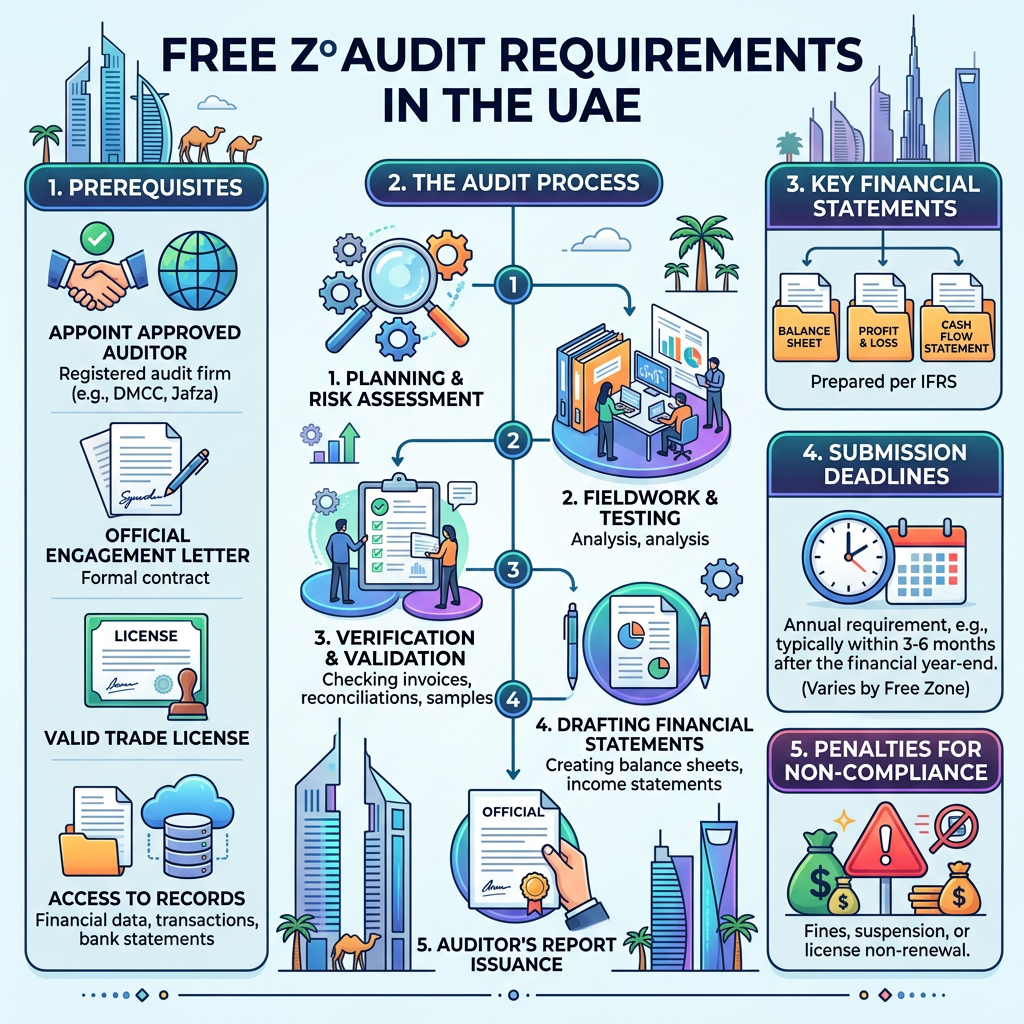
If you set up a freezone company a few years ago on the understanding that audits were only for large businesses, that understanding is now out of date. The old rule was simple: audited financial statements were only required once your annual income passed AED 50 million. From the 2025 tax year onward, that threshold is gone for a specific group of companies, and the group is bigger than most founders realize.
The rule that actually applies to you
If your freezone company is a Qualifying Free Zone Person — meaning it’s claiming the 0% corporate tax rate on qualifying income — you now need audited financial statements regardless of revenue. No income threshold, no small-company exemption. This applies the same way whether you’re in DMCC, JAFZA, RAK Free Zone, Hamriyah, or any other UAE free zone, because the requirement comes from Federal Tax Authority rules, not from any individual free zone’s own regulations.
Separately from the tax-driven requirement, many individual free zones require audited accounts as a condition of licence renewal, independent of your QFZP status. DMCC and JAFZA both fall into this category — audited financials go through the free zone’s own portal using an auditor from an approved list, and the renewal simply doesn’t go through without it.
There’s no meaningful audit-free zone left
A few freezones — Meydan, SHAMS, IFZA, RAKEZ — historically had a reputation as the lighter-touch, audit-free option for smaller companies. That gap has closed between 2024 and 2026, either explicitly through the freezone’s own renewal rules or implicitly through the corporate tax route: even if your specific freezone doesn’t demand an audit for renewal, claiming the 0% QFZP rate does. For an active trading company with any real revenue, there isn’t a practical way to stay both freezone and audit-free anymore.
Auditor approval lists — check this before you engage anyone
DMCC, DIFC, DAFZA, JAFZA, and DDA maintain closed lists of approved auditors, and a submission from a firm that isn’t on the list gets rejected outright, no matter how good the audit itself is. IFZA, Meydan, SHAMS, RAKEZ, and Ajman Free Zone currently accept any UAE-licensed audit firm, as long as the audit itself is IFRS-compliant for FTA purposes. Before you hire anyone, confirm whether your specific freezone runs an approved list — engaging the wrong firm means redoing the audit on a deadline.
Deadlines and what it actually costs
Submission windows vary by zone. DMCC and JAFZA generally require audited statements within 90 days of financial year-end. DIFC and ADGM allow more room — up to 4 to 6 months. Because most companies run a calendar financial year, that puts the practical internal deadline for most freezone businesses somewhere in the first half of the year following year-end, well ahead of the FTA’s own corporate tax return deadline.
On cost: a clean audit for a small trading company under AED 3 million turnover typically runs AED 5,000 to AED 12,000. Mid-sized companies between AED 3 million and AED 15 million in turnover usually land between AED 12,000 and AED 30,000. DIFC and DMCC engagements with approved firms tend to run higher — often AED 18,000 to AED 50,000 — reflecting both the closed auditor list and generally higher compliance standards in those two zones.
What’s actually at stake if you skip it
Two separate consequences stack on top of each other. First, most freezones will simply block your licence renewal until audited accounts are filed — this stops all your operations, not just the paperwork side, since you can’t legally continue trading on an expired licence. Second, and more expensive long-term: failing to maintain proper audited accounts as a Qualifying Free Zone Person puts your 0% corporate tax status at risk. Losing QFZP status doesn’t just cost you the audit fee you skipped — it exposes your qualifying income to the standard 9% corporate tax rate, which for most freezone businesses is a far bigger number than the audit ever would have been.
What to actually do about it
Check your specific freezone’s audit and approved-auditor rules directly — don’t rely on what was true two or three years ago, since several zones tightened their position specifically in 2025 and 2026. If you’re claiming QFZP status, treat the audit as non-negotiable regardless of what your individual freezone’s renewal process technically requires. And engage your auditor early: the zones with closed approved lists get busy in the run-up to their submission windows, and starting the process a few weeks before your deadline gives you no room if anything in your books needs sorting out first.
