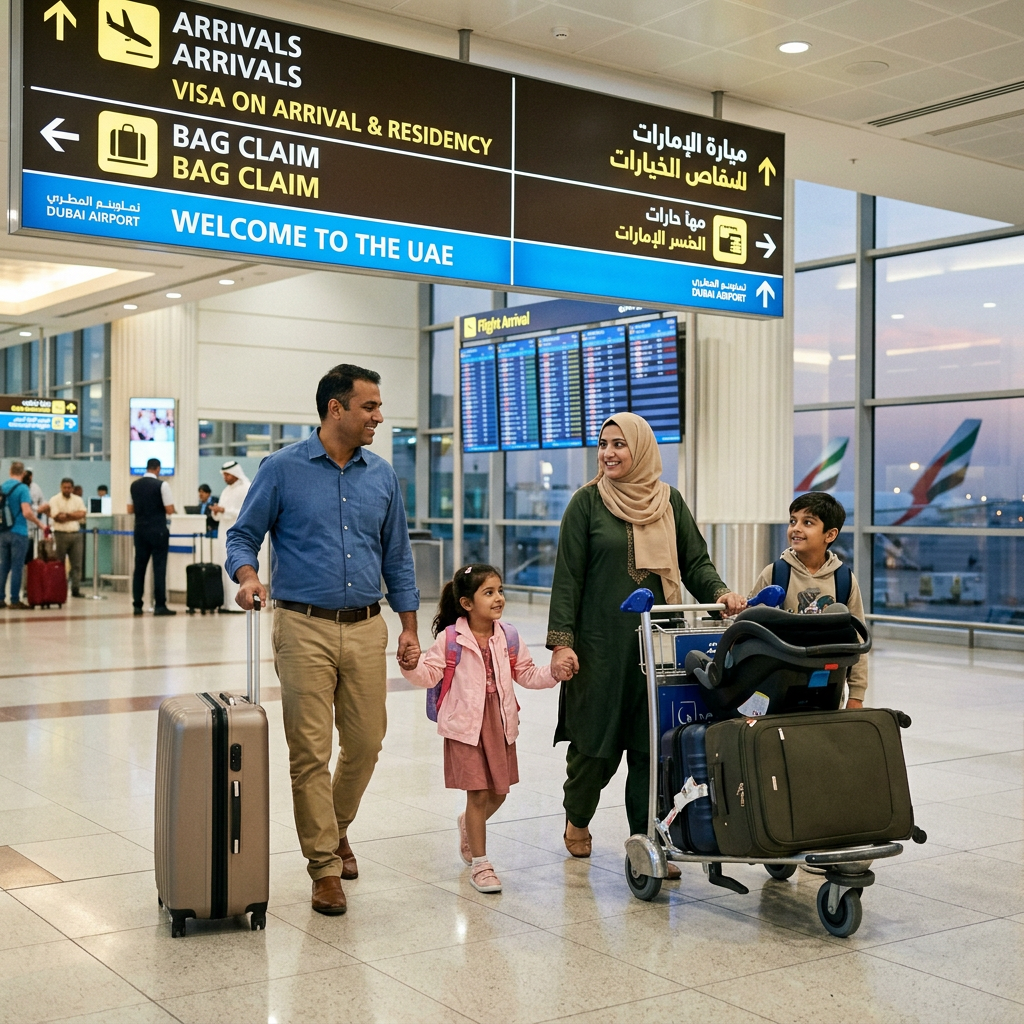
Most of what we write here is about companies. This one is about the reason a lot of people set one up in the first place — bringing their family to the UAE.
The rules are more generous than they used to be in one important respect, and considerably stricter than most people expect in another. Both are worth knowing before you make promises at home.
Who Can Sponsor
You do not need to be an Emirati, and you do not need to be an employee.
Any expatriate holding a valid UAE residence visa can sponsor family members, including those on:
- An employment visa
- An investor or partner visa through their own company
- A long-term residency such as the Golden Visa
What matters is your residence status and your income — not your nationality or how you obtained the visa.
Who You Can Sponsor
This is where the 2026 position differs from older guidance still circulating online.
| Family member | Age limit | Condition |
|---|---|---|
| Spouse | None | Attested marriage certificate |
| Sons | Up to 25 | Ages 18–25 need proof of full-time enrolment at an accredited institution |
| Unmarried daughters | None | Father signs an unmarried undertaking letter once she is 18+ |
| Children with special needs | None | Supporting documentation required |
| Parents | None | Substantially higher salary threshold — see below |
The extension for sons to age 25 is the significant change. Previously families faced a hard stop at 18, which forced students either onto their own student visa or out of the country. If you have a son approaching 18 and were bracing for that, the position has improved — but note the enrolment condition is real, and proof is requested.
The Income Thresholds
Here is where expectations and reality most often diverge.
Spouse and Children
- AED 4,000 per month, or
- AED 3,000 per month if your employer provides accommodation
These are achievable for most people in professional employment, which is why family sponsorship feels routine when discussed in general terms.
Parents — A Different Proposition Entirely
- AED 20,000 per month for standard parent sponsorship in Dubai
- AED 10,000 per month via the GDRFA humanitarian residence route, applied for through Amer centres
- A refundable security deposit of AED 5,000 to AED 10,000 is also required
That AED 20,000 figure is five times the spouse-and-children threshold, and it is the single most common source of disappointment we encounter. Many people assume that if they can sponsor a spouse, parents follow naturally. They do not.
If bringing your parents is the actual goal, check the threshold before anything else. It determines whether the plan is viable at all.
The humanitarian route at AED 10,000 is genuinely worth investigating if you sit between the two figures — it is less widely known than it should be, and Amer centres handle it directly. It also requires an attested tenancy contract and three months of bank statements.
If You Are Below the Threshold
Falling short of AED 4,000 does not automatically end the matter. A bank guarantee deposit route exists, typically AED 3,596 or AED 5,296 depending on circumstances.
This is worth asking about rather than assuming you are ineligible — but treat it as a route to explore with a typing centre or consultant, since applicability varies by case.
What It Costs
Budget AED 3,000 to AED 8,000 or more per dependent. The range reflects visa duration, whether the applicant is inside or outside the UAE, and how much of the process you outsource.
For each dependent you are typically paying for:
- Entry permit
- Status change, if they are already in the country
- Medical fitness test (adults and children over 18)
- Emirates ID
- Visa stamping
- Health insurance — mandatory, and a prerequisite for Emirates ID
A family of four is therefore a meaningful outlay, and it recurs at renewal. Health insurance in particular is an ongoing annual cost per person that people routinely leave out of their planning.
Documents to Prepare Early
The application itself is not difficult. The delays come almost entirely from documents that need attestation from abroad.
- Attested marriage certificate — for spouse sponsorship
- Attested birth certificates — for children
- Salary certificate or employment contract — proving income
- Ejari-registered tenancy contract — your accommodation must be appropriate for the family size
- Three months of bank statements — particularly for parent sponsorship
- Passport copies and photographs for every applicant
Attestation of foreign documents runs through your home country’s authorities and then the UAE Ministry of Foreign Affairs. It can take weeks. If you know family sponsorship is coming, start attestation before you need it — this is the step that turns a four-week process into a three-month one.
Sponsoring Family as a Company Owner
Most guidance on family visas assumes you are an employee with a salary certificate from an employer. If your residence comes from your own company, a few things work differently.
- Proving income takes more work. There is no third-party employer to issue a salary certificate. You will generally be demonstrating income through your company’s bank statements, a salary certificate issued by your own company, and in some cases audited accounts.
- Your visa quota applies. Dependent visas draw on your establishment’s allocation in some structures. Check what your licence package permits before applying.
- Everything rests on the licence. Your residence visa depends on your trade licence remaining valid, and your family’s visas depend on yours. A lapsed licence does not only affect you — it puts your dependants’ status at risk too.
That last point is the one worth internalising. For an employee, a visa problem is between them and their employer. For a company owner, licence renewal, corporate tax filings and family residency are all connected. It is a strong practical argument for keeping compliance current even in a quiet trading year.
Golden Visa Holders
If you hold a Golden Visa, family sponsorship is one of its principal advantages — you can sponsor your spouse and children for the full duration of your own residency, without the visa being tied to an employer or a trade licence remaining active. For families whose main concern is long-term stability, that independence is often worth more than the headline ten-year term.
The Order That Works
- Confirm your own residence visa is valid with sufficient time remaining
- Check your salary meets the threshold for the specific family member
- Begin attestation of marriage and birth certificates now
- Ensure your Ejari tenancy contract is current and suits the family size
- Apply for the entry permit
- Complete medical testing and Emirates ID registration
- Arrange health insurance before Emirates ID issuance
- Complete visa stamping
Points People Get Caught By
- Your accommodation is assessed. A studio apartment may not be accepted as suitable for a family of four. The Ejari contract is part of the application, not a formality.
- Sons turning 25 lose eligibility. Plan the transition to a student or employment visa in advance rather than at expiry.
- A daughter’s marriage changes her status. The unmarried undertaking is a declaration with consequences if circumstances change.
- Your visa is the foundation. If your own residence lapses, dependent visas tied to you are affected. This matters particularly for company owners whose visa depends on a licence staying current.
If Parents Are Out of Reach
Worth saying plainly, because it is a common situation: if you cannot meet AED 20,000 or the AED 10,000 humanitarian route, long-term parent sponsorship may not be available to you right now.
The practical alternative most families use is a multi-entry visit visa, renewed periodically. It is not residency, it does not provide an Emirates ID, and it requires exits and re-entries — but it allows extended stays and is considerably cheaper.
It is not what people hope for. It is usually better than the assumption that nothing is possible.
A Necessary Note
This is general information rather than immigration advice. Requirements differ between emirates — Dubai’s GDRFA applies its own thresholds and processes, and other emirates vary. Rules in this area also change reasonably often, as the extension for sons to 25 demonstrates.
Confirm your specific position with GDRFA, an Amer centre, or a qualified consultant before committing to arrangements at home.
Over to You
This one is personal for a lot of people, so we would genuinely like to hear how it went:
- How long did attestation take from your home country?
- Has anyone used the AED 10,000 humanitarian route for parents, and how did you find it?
- For those with sons who turned 18 recently — how straightforward was the enrolment proof?
Share it in the comments. Family sponsorship is an area where the official requirements and the actual experience differ quite a bit by nationality and emirate, and firsthand accounts help other families plan realistically.
And if you want your own eligibility checked before you start — particularly for parents, where the thresholds are unforgiving — our consultations are free, and we would rather tell you early than let you plan around something that will not be approved.